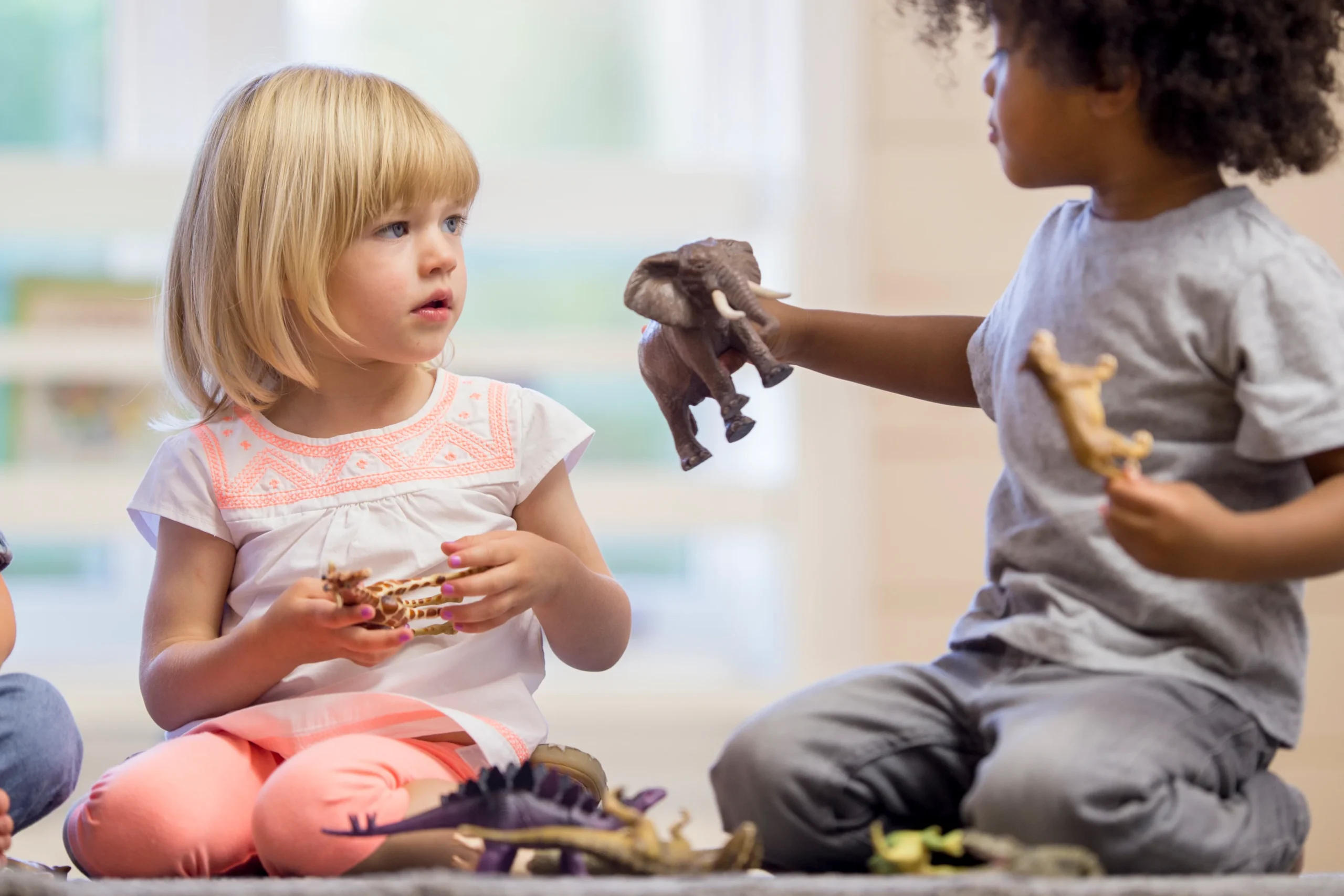
“Share your toy.”
“Let your friend have a turn.”
“You need to learn to share.”
These phrases are repeated constantly in toddlerhood, often with the belief that sharing equals kindness and good behavior.
When toddlers resist, adults may feel embarrassed, frustrated, or worried they are raising a selfish child.
Montessori philosophy offers a completely different perspective—one that removes shame, reduces conflict, and actually leads to more genuine generosity over time.
The truth is, toddlers don’t need to share yet.
And forcing them to do so often causes more harm than good.
Why Sharing Is a Developmental Mismatch for Toddlers
Toddlers are in the early stages of understanding themselves as separate individuals. Their sense of ownership is strong, emotional regulation is still developing, and empathy is only beginning to emerge.
To a toddler, a toy isn’t just an object. It feels like an extension of themselves.
When an adult demands sharing, the toddler’s brain doesn’t interpret it as a social lesson. It interprets it as loss, unfairness, or threat.
Montessori respects the child’s developmental stage instead of pushing social expectations too early.
The Difference Between Sharing and Turn-Taking
One major misunderstanding in early childhood is treating sharing and turn-taking as the same skill.
Sharing is voluntary.
Turn-taking is structured.
Toddlers are not developmentally ready for voluntary generosity on demand. Montessori does not expect toddlers to give up items mid-use. Instead, it teaches respectful turn-taking supported by adults.
This reduces power struggles and builds patience naturally.
What Happens When Toddlers Are Forced to Share
Forcing sharing often leads to:
More grabbing and hitting
Increased tantrums
Loss of trust in adults
Greater possessiveness
Instead of learning kindness, toddlers learn that their boundaries don’t matter.
Montessori avoids this by protecting a child’s right to finish what they are using.
Montessori’s Core Principle: Respect the Child’s Work
In Montessori, play is considered a child’s work. Interrupting a child’s work is seen as disrespectful.
If a toddler is using a toy, they are allowed to continue until they are finished. Another child must wait.
This simple rule removes competition and adult judgment from the situation.
Children learn patience not through lectures, but through experience.
Why Waiting Is a Powerful Skill
Waiting teaches toddlers:
Impulse control
Emotional regulation
Frustration tolerance
These are skills toddlers can develop.
Sharing, when forced, teaches compliance without understanding. Waiting builds internal control.
Montessori values waiting because it aligns with a toddler’s developmental abilities.
How Montessori Adults Respond During Toy Conflicts
Montessori guides adults to stay calm and neutral.
Instead of saying:
“You have to share.”
The adult might say:
“He is using it right now. You may have it when he is done.”
This protects both children’s needs without blame or shame.
The adult acts as a calm boundary, not a judge.
Giving Toddlers the Language Before the Skill
Montessori emphasizes language development before social expectations.
Toddlers are taught phrases like:
“I’m using this.”
“You can have it next.”
“Can I have a turn when you’re done?”
Language replaces grabbing. Communication replaces conflict.
Over time, this leads to more cooperative play.
Ownership Creates Emotional Security
When toddlers know their belongings won’t be taken away arbitrarily, they feel safe.
Safety reduces defensiveness.
A child who feels secure is more likely to share voluntarily later.
Montessori understands that generosity grows from security, not pressure.
When Does Real Sharing Actually Develop?
True sharing develops later, usually between ages four and six, when empathy, perspective-taking, and impulse control are more developed.
Montessori does not rush this process.
Instead, it lays the groundwork through respect, patience, and modeling.
Sharing that develops naturally lasts longer than sharing enforced early.
Modeling Generosity Instead of Demanding It
Children learn more from what adults do than what they say.
Montessori adults model kindness, turn-taking, and patience in everyday interactions.
When children observe generosity in action, they internalize it naturally.
No lectures required.
What to Do When Your Toddler Takes a Toy
If your toddler grabs a toy, Montessori encourages calm intervention.
A gentle response might be:
“He was using that. Let’s give it back.”
No shaming. No punishment.
This teaches respect while maintaining emotional safety.
Navigating Social Pressure From Other Adults
One of the hardest parts of this approach is handling expectations from other parents.
If someone insists your child should share, a calm response can be:
“She’s using it right now. She’ll be done soon.”
This protects your child’s boundary while modeling respectful communication.
Why Forced Sharing Can Increase Aggression
When toddlers feel powerless, aggression often increases.
Hitting, biting, or screaming become ways to regain control.
By protecting a toddler’s right to use an object, Montessori reduces the need for aggressive behavior.
Many Montessori environments see fewer conflicts because children feel respected.
Long-Term Effects of the Montessori Approach
Children raised with this philosophy often develop:
Stronger boundaries
Greater empathy
Better conflict resolution
More genuine generosity
These children share because they want to, not because they are told to.
Applying Montessori Sharing Principles at Home
You don’t need a Montessori classroom to use these ideas.
Avoid forcing sharing.
Support waiting.
Protect a child’s right to finish an activity.
Offer duplicates when possible.
Model patience and kindness.
Small changes in language and expectations can dramatically reduce daily stress.
What This Teaches Toddlers About Relationships
This approach teaches toddlers:
My needs matter.
Others’ needs matter too.
Adults will protect me.
I don’t need to fight to be safe.
These lessons form the foundation for healthy relationships.
Why This Feels Uncomfortable for Adults
Many adults were taught that sharing equals good manners. Letting a child keep a toy may feel wrong at first.
But Montessori asks adults to look beyond appearances and focus on development.
Kindness cannot be rushed.
Toddlers don’t need to share to become kind, generous adults. They need respect, time, and guidance that matches their development.
Montessori teaches that true generosity grows from emotional safety—not pressure.
When toddlers feel secure, understood, and respected, sharing emerges naturally.
And when it does, it lasts.
Leave a Reply